You Won’t Believe This Secret Dinner Spot in Key West
Hidden beneath Key West’s tourist buzz is a dining experience most never find. I’m talking about an unmarked courtyard behind a vintage saloon, where locals slip in after sunset for grilled mahi-mahi kissed by smoky guava wood. No signs, no menus online—just word-of-mouth magic. I stumbled on it by chance, and honestly? It changed how I see island food. This isn’t just dinner; it’s a whispered secret among fishermen, artists, and sunset chasers. In an age where every meal seems curated for the camera, this place remains untouched, unphotographed, and unforgettable. It stands as a quiet rebellion against the predictable, a reminder that the most meaningful moments in travel are often the ones you don’t plan.
The Allure of Hidden Dining in Key West
Key West has long been a destination of contrasts—where pastel-colored cottages sit beside bustling tourist strips, and cobblestone streets echo with both steel drum rhythms and the whispers of literary ghosts. Amid this layered identity thrives a culture of hidden dining, a quiet network of unlisted kitchens, backyard pop-ups, and family-run supper clubs known only to those who take the time to listen. These spots are not found through search engines or glossy travel magazines but through late-night conversations on dockside benches or recommendations passed between friends over rum cake at a local bake sale.
What makes these underground eateries so compelling is not just their secrecy, but what that secrecy represents: authenticity. In a world where every destination risks becoming a carbon copy of the last, places like this resist the pull of commercialization. They operate on trust, word-of-mouth, and a shared understanding that some experiences are too special to be mass-marketed. Locals guard them carefully, not out of exclusivity, but out of love—for their community, their traditions, and the island’s soul.
For travelers, stumbling upon one of these hidden kitchens feels like unlocking a secret level in a game only the island knows how to play. It’s not just about the food, though that is always exceptional. It’s about the sense of belonging, even if only for an evening. You’re not a customer; you’re a guest. And in that shift—from transaction to connection—lies the real magic of Key West’s underground dining scene.
How I Found the Unmarked Courtyard Kitchen
My discovery began on a golden evening in late October, the kind where the air is warm but carries a whisper of salt and breeze. I had spent the day wandering Duval Street, browsing art galleries and sipping iced tea under striped awnings. As the sun dipped lower, painting the sky in streaks of coral and lavender, I followed the sound of laughter down a narrow alley tucked behind a weathered saloon with a faded pirate flag flapping above its door. The path was barely wide enough for two people to walk side by side, lined with bougainvillea spilling over crumbling stucco walls.
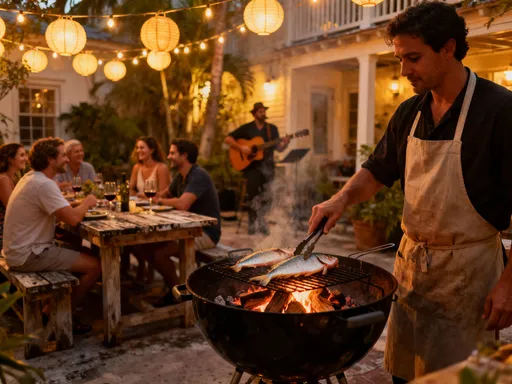
Then I saw them: strings of Edison bulbs swaying gently above a low archway, casting a honeyed glow over a courtyard I hadn’t known existed. The scent hit me next—grilled fish, charred just enough to carry a hint of smoke, mingling with the sweetness of ripe mango and the sharp tang of fresh lime. Someone was playing guitar softly in the corner, and a woman in a sun-bleached sundress poured rum punch from a glass pitcher into mismatched mason jars.
I hesitated at the entrance, unsure if I was intruding. But a man with salt-and-pepper hair and a well-worn apron smiled and waved me in. “First time?” he asked. I nodded. “Good,” he said. “You’re supposed to find us by accident.” There was no host stand, no reservation book, not even a sign. Just a chalkboard propped against a potted palm, listing the night’s offerings in looping cursive—no prices, no descriptions, just names like “Today’s Catch” and “Island Greens.” I took a seat at a long wooden table already shared by a fisherman cleaning his hands with a citrus wipe and a young couple sketching in a shared notebook.
It felt less like entering a restaurant and more like being welcomed into someone’s home—a home where the kitchen was always on, the music never stopped, and strangers became companions by the second round of drinks. The sense of privacy, of intimacy, was immediate. Phones stayed in pockets. Conversations flowed freely. And for the first time in a long while, I wasn’t thinking about capturing the moment. I was simply in it.
What Makes the Food So Different?
The meal began with a basket of plantain chips, fried to order in small batches and sprinkled with sea salt and a pinch of smoked paprika. They crackled between my fingers, warm and crisp, and paired perfectly with a creamy avocado dip streaked with roasted garlic. But it was the grilled mahi-mahi that stole the show—thick, buttery fillets seared over an open flame fueled by guava and mango wood, giving the fish a delicate sweetness that no gas grill could replicate.
Every ingredient had a story. The fish was caught that morning by a local captain who docks his boat just a few blocks away. The limes came from a backyard tree behind a cottage on Simonton Street. The conch fritters—golden, airy, and perfectly spiced—were made from shellfish harvested in the shallow reefs south of the island, battered in a family recipe passed down for generations. Even the rum in the punch was distilled on the island, aged in small barrels behind a converted warehouse near the harbor.
But the true standout was the lobster-stuffed avocado, a dish so simple it bordered on genius. Fresh avocado halves were filled with a warm mixture of claw meat, sautéed shallots, cherry tomatoes, and a touch of lime crema so rich it melted on the tongue. It arrived on a chipped ceramic plate, garnished with micro cilantro from a window box on the chef’s back porch. There was no pretense, no plating for aesthetics—just food made with care, meant to be eaten slowly, shared openly.
What set this meal apart wasn’t just the quality of the ingredients, but the intention behind them. There were no imported cheeses, no out-of-season berries flown in from South America. Every bite reflected the island’s rhythm—the tides, the harvest, the weather. The kitchen operated on what was fresh, what was available, what felt right. And in that simplicity, there was profundity.
Who Runs This Place? The Chef Behind the Secret
The man behind the grill goes by Mateo, though few know his full name. He’s in his late fifties, with forearms bronzed by years of outdoor cooking and eyes that crinkle when he laughs. Before settling in Key West, he spent two decades in Miami’s fine-dining circuit, working in Michelin-recognized kitchens, mastering French techniques, and earning praise for his precision and creativity. But over time, the pressure, the critics, the relentless pursuit of perfection began to weigh on him.
“I was cooking for reviews,” he told me one evening, turning a piece of snapper with a well-worn spatula. “Not for people.” So he left. No farewell tour, no press release—just a quiet exit. He bought a small house on the edge of Old Town, grew a garden, and started hosting dinners for friends. Word spread. Friends brought friends. And slowly, almost without intention, the courtyard became a sanctuary for those seeking something real.
Mateo still cooks with the skill of a trained chef, but his philosophy has shifted entirely. There are no reservations. No online presence. No ratings to chase. He cooks what he wants, when he wants, and stops when the food runs out. “If you have to turn people away,” he says, “it means you did it right.” He refuses interviews, turns down cookbook offers, and politely declines influencers who ask to film their meals. “This isn’t a brand,” he says. “It’s a table.”
His humility is not performative—it’s deeply rooted. He sees himself not as a star, but as a steward of tradition, of place, of connection. And in a world obsessed with visibility, his choice to remain unseen is its own kind of courage.
How to Find It (Without Spoiling the Magic)
Finding the courtyard requires a blend of curiosity and restraint. It’s not listed on any map, and no app will guide you there. But if you wander with your ears open and your pace slow, the clues appear. Start near the heart of Old Town, where the streets curve like ribbons and the buildings wear their history proudly. Look for a turquoise dive bar with a wooden parrot perched above the door, its feathers faded by decades of sun. Step inside for a drink if you like—their frozen daiquiris are legendary—but don’t stay too long.
When you leave, turn left toward the water, passing a mural of an old cigar factory that once employed hundreds. Just beyond it, a narrow passage veers right, half-hidden by a tangle of jasmine vines. Follow it. If you hear music—if you smell woodsmoke and citrus—you’re close. The archway is unmarked, but the light will guide you.
That said, with knowledge comes responsibility. This place survives because it remains small, respectful, and unspoiled. Please honor the no-photos policy. Not because it’s forbidden, but because the moment loses its meaning when it’s captured for an audience. Let the memory live in your mind, not on a screen. And whatever you do, don’t share the exact location online. The joy of discovery is part of the experience. Let others find it the same way you did—by accident, by instinct, by grace.
When to Go and What to Expect
The courtyard opens informally, usually around 5:30 p.m., and begins to fill as the afternoon light softens. Arriving early increases your chances of securing a seat at one of the communal tables, though standing near the back with a drink in hand is no hardship. The rhythm of the evening unfolds naturally—steel drum music starts at dusk, played by a rotating group of local musicians who come not for pay, but for the joy of playing.
There’s no formal service. Dishes are brought out as they’re ready, often placed in the center of the table for everyone to share. Conversations spark easily—between travelers from different countries, between longtime residents and first-time visitors. Stories are exchanged. Laughter rises and falls like the tide. Children chase fireflies under the lanterns while adults linger over second helpings of key lime pie made with zest from a tree out back.
But be prepared: the kitchen closes when the food runs out. There are no second batches, no reheated leftovers. If you arrive late, you might miss the lobster or the grilled octopus. And that’s by design. The unpredictability is part of the charm, a reminder that some things cannot be scheduled or guaranteed. It teaches patience. It rewards presence. And in doing so, it transforms a simple meal into a lesson in letting go.
Why This Experience Matters in Modern Travel
In an era where every destination is rated, reviewed, and replicated, places like this courtyard kitchen are endangered. They resist the algorithms, the filters, the endless scroll of curated perfection. They remind us that the best travel experiences are not found in guidebooks, but in the spaces between them—in alleys, in whispers, in shared glances over a plate of grilled fish.
True discovery requires more than GPS. It asks for openness, for patience, for the willingness to get lost. It demands that we listen to locals, not just influencers. That we value connection over content. That we accept uncertainty as part of the journey. And when we finally find something real—something unpolished, unbranded, unrepeatable—we recognize it not because it looks perfect, but because it feels true.
This hidden dinner spot is more than a meal. It’s a philosophy. It’s a quiet protest against the homogenization of travel, a celebration of place and people over profit and publicity. It proves that even in the most touristed corners of the world, authenticity can still thrive—if we’re willing to look for it, respect it, and protect it.
So the next time you travel, slow down. Talk to someone. Follow a scent, a sound, a feeling. Don’t rush to document everything. Some moments are meant to be lived, not shared. And the most memorable meals? They’re not served on fine china or plated with tweezers. They’re earned—with curiosity, with humility, with heart. This is the secret of Key West’s hidden kitchen. And now, it’s yours.